


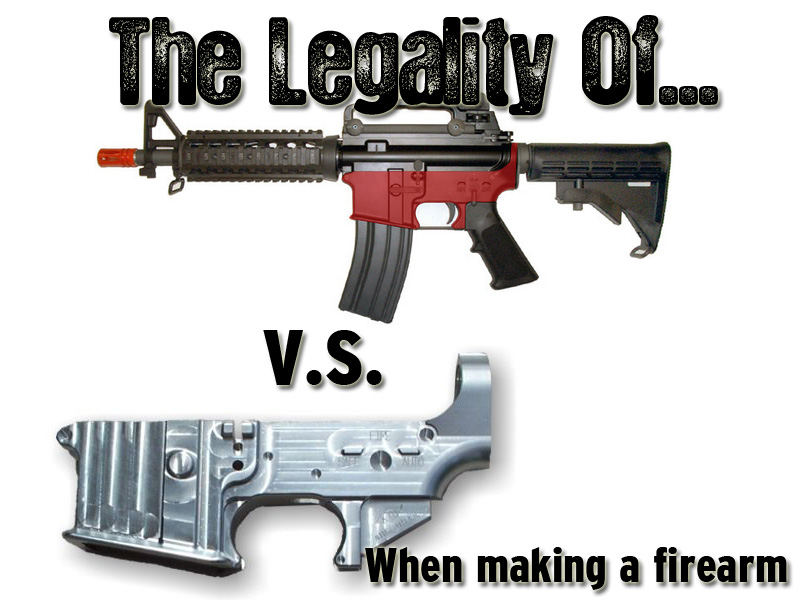
I was thinking some more about that recent ATF airsoft seizure and came up with the following…
For your information, per provisions of the Gun Control Act (GCA) of 1968, 18 U.S.C. Chapter 44, an unlicensed individual may make a “firearm” as defined in the GCA for his own personal use, but not for sale or distribution.
The GCA, 18 U.S.C. § 921(a)(3), defines the term “firearm” to include the following:
… (A) any weapon (including a starter gun) which will or is designed to or may be readily converted to expel a projectile by the action of an explosive: (B) the frame or receiver of any such weapon; (C) any firearm muffler or silencer; or (D) any destructive device. Such term does not include an antique firearm.
Source – ATF.gov
Another paragraph of interest…
Individuals manufacturing sporting-type firearms for their own use need not hold Federal Firearms Licenses (FFLs). However, we suggest that the manufacturer at least identify the firearm with a serial number as a safeguard in the event that the firearm is lost or stolen. Also, the firearm should be identified as required in 27 CFR 478.92 if it is sold or otherwise lawfully transferred in the future.
Source – ATF.gov
So… According to the ATF’s citations of the Gun Control Act and U.S. Code, you can make your own firearm and you do not need a FFL.
The ATF does not specify what material you have to use, and it does not put any restriction on making a firearm out of an object that previously had another use. Hell, if you wanted to make a firearm out of a toaster, from what I understand you definitely could.
By that rationale, if you buy an airsoft gun that “Needs Machining” to complete its transformation to fit an AR-15 lower parts kit, is it not only considered a firearm once you complete it?
If you cannot drop a lower parts kit in those airsoft receivers without any machining then I think that is a VERY good argument that they are not firearms, and should never have been confiscated.
Comments
33 responses to “80% AR-15 Lower Receiver V.S. Airsoft Lower Receiver – Is there a legal difference?”
I recall once reading in a forum something about manufacturing your own weapon. The advice given by the “expert” on this particular forum and subject was that if you were manufacturing your own firearm you had to do all of the work yourself. It went so far as to say that if you need a piece of metal bent in a particular way, a gunsmith should show or explain to you how to do it but not do it himself. I believe it said that a responsible gunsmith wouldn’t do the work for you anyway, because he would know that it meant he had participated in the manufacture of a weapon that would then not be manufactured by one individual.
I’ll try to look for some references for that thought, but it seems like, based on what I read, legally manufacturing your own firearm without a license requires far more than putting parts together or simply machining an existing part. It has to be essentially from scratch. From materials or parts not resembling a firearm in any way. So, while toaster-to-gun may very well be legal, I don’t think a toy gun-to-gun would ever fly with the ATF.
Actually… no.
There is no law against building your own. Only law that exists against building a firearm,, is building a machinegun. And in some weird governmental way… a machinegun is a machinegun, not a firearm.
on board here yet?
You can take and buy a parts kit AK, assuming that owning such a normal firearm is allowed to you by the local gods… er… officials, and bend your own receiver. Or, buy a receiver, just a receiver, because in ATF land, that metal flat that can accept all the parts and has a serial number is a firearm, not the sum of the parts.
Bottom line, you can roll your own, as long as you dont do it in certain ways.
What Mike is gettign at is an 80% receiver. Its the beginnings of a receiver, but only has about 80% of the work done, so it is not yet serialed and finished, and cannot be readily made into a working rifle or pistol.
There is a difference between “manufacturing” your own weapon, and assembling one from parts. When you’re manufacturing your own weapon, you do so by yourself, with parts that were not manufactured, machined, or necessarily intended to be used as or in a firearm. So, you can do so without ever having to register anything or without anything having a serial number on it, or record of being manufactured. What you’re talking about with an 80% receiver is a firearm component. Firearms components are covered under 27 C.F.R. §447.21 – U.S. Munitions Import List, and §447.22 – Forgings, Castings, and Machined Bodies. As such, importers of these items are required to be registered, per §447.31, with the federal government.
Wasn’t the whole point of this story originally that they were importing “firearms” without the required licenses? So… you can’t import firearm receivers without being licensed to do so. You can build your own from scratch without a license and you can assemble one from parts without a license, but I think what the law is saying is that those firearm components can not be manufactured and sold by someone without a license. And I think the point about someone helping you is that if you don’t do all of the manufacturing work yourself then someone else is also a manufacturer, therefore it’s not being done by one individual for their own use, and so requires registration.
My understanding that an 80% receiver had all the legalities of a block of wood. 81% (however that is determined) and it could be considered as such.
That was my understanding as well. I don’t know how they determine what exactly is only 80% but a 80% or less frame of anything isn’t a gun it’s a piece of metal.
Also I was told that you only need to apply for a manufacturing license if you made more than 20 guns a year. I don’t know why 20 but that’s the number. Also I was told you only have to put a serial number and get a tax stamp on it if you want to sell it.
I’m not a lawyer though so I wouldn’t really listen to me.
My understanding was always that there is no set number you can build, but that it is all about intent.
If you intend to build it for yourself/ your own personal use then you are fine regardless of how many you build. If you intend to build it for sale then you have trouble (even if it’s just a single firearm)
Note that “80%” is a marketing term. ATF defines things as “firearm” or “not a firearm.” If adjusting a couple of holes allows a trigger kit to fit, that would be considered a firearm–because it could fire one shot, whether or not a magazine will fit.
ARs are almost unique in that the lower –what on most guns is the trigger housing–is the numbered receiver, and not the upper that the barrel attaches to.
It is permissible to have someone do work for you, provided you are present during the process. You can have someone mill a bridge or drill a hole in your presence, you just can’t send it to them to be done. Just as an FFL can have employees do work for him, without them having their own FFLs.
This represents my understanding, IANAL, and nothing beats paper from the ATF Technology Branch, who respond to most questions in about a month.
I hear this alot but it is actually wrong there are lots of firearms that have the lower seralized. I.E. all 1911’s all S&W pistols, Glocks, Taurus, well you get the point almost all pistols, shot guns, and many rifles. You can even buy barrels, bolts, and pistol uppers on ebay.
Casey,
I really hate being so nit-picky, but since this is a legal discussion I need to point this detail out. For there to be a “lower” receiver there must be an upper receiver. None of the firearms you listed have an upper receiver. And, except for a few pistol variants derived from rifles (i.e. the AR-15), pistols do not have an upper receiver. Please don’t confuse the slide as an upper receiver, it is a slide and part of the action. A pistol receiver, like most firearms, has a one piece receiver. An AR-15, almost unique among firearms, has a two piece receiver.
To further explain Michael’s point, he also stated that the upper receiver is what the barrel is attached to. I believe he mentioned this because it is very unusual among rifles with fixed barrels. In all cases that I can think of the barrel is attached to the serialized part of the gun. The AR-15 is unusual in that the barrel is attached to the non-serial numbered half.
The point here, is that an 80% receiver needs minor work to accept trigger parts in order to make it a legal-in-the-eyes-of-the-ATF receiver. And that doing said work, assuming you’re legal to own a firearm in the first place, is legal to do.
In which case, taking an airsoft receiver and MODIFYING it to accept firearm trigger parts (and presumably uppers, etc.) is, or should be, a legally identical action. Meaning that, if it’s legal for you to own the finished firearm, then doing the mod to the airsoft receiver should be legal.
It sounds like it WOULD be legal if either the airsoft “receiver” was only 80% complete or if the receiver were a legal firearm receiver (and imported as such). It seems that neither of those is true though. In looking for info about 80% complete receivers I found this website selling them:
http://www.tacticalinc.com/ar15-lower-receiver-forging-p-1108.html
As you can see, it appears to be nothing more than a very rough forging of a lower receiver with NO machining done to it. It seems that there may not be a precise definition of what an 80% receiver is, but the ATF has ruled that machine work such as drilling holes would “designate its purpose” and push it past the 80% threshold. Obviously this airsoft gun is going to have had more work done to it than that to make it usable even as a toy. So it doesn’t appear to qualify as an 80% receiver, and it hasn’t been properly imported as a firearm component.
An %80 receiver is much more finished than the one you linked to.
http://www.vbd.com/noc/shop/products_detail.asp?CategoryID=29&ProductID=122
Much of the finishing is already done.
Josh…at the link you posted that was NOT an 80% receiver….it was a RAW FORGING which is about 30% of the process. The fact is the ATF doesn’t look at the percentage of completion they look at firearm vs non-firearm and each have a specific definition. Now I will say the ATF is guilty of contradiction and not following its own rules but they have more money, more thugs with guns, and the backing of the rest of our corrupted government so they can do as they please until the American public loses their apathy and grows a pair of balls and the will to fight back. Anyway….to get an 80% receiver from the raw forging in the link you posted tacticalinc.com will complete EVERY process EXCEPT for the Fire Control Group Well. Here is an example…..
http://www.practicalmachinist.com/vb/attachments/f24/23302d1275177063-80-7075-billet-ar-15-lowers-fs-blasted_lower_right_side_med.jpg
It seems that the problem is not of the 80% blah.
I researched because the report said that the batfe goon said it can be transformed into a machinegun.
http://www.airsplat.com/Manuals/GR-WE-M4-GBB-4.jpg
on that page you can see it has the milled hole at the 12’o clock of the safe, in an AR lower, if you mill that little hole, you are making a machinegun, because that’s where the sear retent pin goes (or something like that), even if the parts still don’t fit, that hole alone makes it a machinegun.
The only thing I can see that could defend the WE M4 CQB, is that the stock threading on the lower is not compatible with a stock threading of an actual AR stock, If there’s no stock tube, no action spring can be put, and there won’t be a buffer to be returned, hence, it WONT cycle on it’s own, making it a bolt action 80% lower.
If it can be attached to an upper and fire a single shot, it constitutes a firearm. Even if it were to blow up in the process.
On the WE M4, the little ‘hole’ you see over the safety is not a hole. It’s an exterior mark on the lower, but not hole is drilled there. This is no closer to a machine-gun than a real AR lower is, in that you could drill either one, but neither has an existing hole.
As a former posted had questioned, ‘Don’t you have to build the whole gun from scratch?’ No. You can buy the upper, bolt carrier, and all other parts you need fully machined and completed via regular sale. You can buy the parts kit. The only part that needs any work to be completed is the receiver itself. Also, that receiver does not have to be completely built from scratch. It only requires that it be less than %80 complete. You can buy a nearly finished AR15 receiver, with the locking pin holes and interior machining already done, and all you have to do is thread the rear for the stock tube. It’s a small percentage of the work. So, no, you do not have to build the whole thing from scratch.
Anyone who would use a lower receiver from an airsoft gun to modify for use as a real firearm is a moron. Those are made from cheap pot metal and I personally wouldnt even trust one to withstand firing 1 round.
the only part of the weapon that needs to be pressure rated per say is your chamber, barrel bolt and carrier and gass system. No pressure is built up in the lower reciever nor the upper reciever from the bolt lock back. Use plastic or pot metal would be fine. Obviously the stronger material used would be better for durability, but i bet thats what the old timers said when they got thier first aluminum piece of crap that would fly apart when the first bullet went thru it. But guess what that aluminum POS is the most versatile weapon system ever created and is extremely reliable, if kept clean.
Actually Dave, Prime makes a fully CNC AR lower for airsoft…hardly pot metal.
Dave, I have fired at least 20 30rd mags through an AR with a 3d printed PLASTIC lower. Fired just fine and that particular gun is still going strong
A few high end gas blow back rifles are made from 7075 aluminium, a higher grade aluminium than the real steel 6061 that is used in most AR receivers… but to turn a gbb into a real gun, you’ll need to change the barrel, the bolt, the trigger unit, lots of milling and turning so the parts would even fit. Unless ofcourse, you buy an airsoft gun, replace the upper receive with a real one, and then take off the lower receiver, and replace the lower receiver with the real ones, and then proceed to replace the rest with real parts, then voila, you have a real gun.
So it is legal to build your own gun. Does it have to be semi-auto, single shot, full auto, muzzle loader. What are the laws in regards to that?
Full auto is considered a machine gun and is not allowed
Bucky, it just has to fit the legal parameters for your locality and the USA.
If you’re in a restrictive area that doesn’t allow assault type rifles, it’s a lot different.
However, as far as the feds are concerned, it simply can’t be fully automatic or have the provisions to make it so.
You guys sound like tards discussing 80% ar lowers your toy guns cannot fire real live rounds no matter what you modify on them. If you are going to start modifying one of your toy ar’s to fire live rounds you might as well buy a real one alot cheaper. 80% ar lower are not anything more than a metal paperweight looking at your last comments the hole at the 12 o’clock position on the schematic would never make an ar fully auto dipstick to make or convert want new are you would need a DIAS or a lightning link which
are illegal don’t let anyone bull CRAP u into thinking its possiblei
An 80% lower is exactly what it says 80% finished meaning u need to do 20 percent of the end to finish it milling the trigger slot drilling the holes for selector and pin holes and no u yourself don’t have to do the work yourself if u find space with an auto CNC machine as long as u push the power button yourself there is s place I’m Orange County California that will help 65 $ other cheaper route you can do it your self if u have a drilling machine just buy the jig for the 80% lower and a couple of milling bits and it of patience and you can do one in about 3 hrs
Legally you are allowed to make as many as u want no ffl required as long as u don’t sell trade or give away they or it is meant for personal use
Skysurfer do you know the name of the company that you was talking about I think I had the web page but lost it they sold their lower for $149.00 and I could have the work completed for $65.00 at soe place in Southern California. Skysurfer could you please send me any information that may assist me so that I can complete my 80% lower at a later date and time. Thank you for your assistance.
The airsoft guns seized were gas blowback instead of electric. The problem is that the lowers of these airsoft guns are mechanically very similar to a real m16. File a few parts and put a heavier spring in the hammer assembly and throw on an ar15 upper and you have a fully automatic firearm.
Sure it’s not as strong and would never meet quality assurance standards of a real gun, but it is possible to convert them over.
That said john browning made some of the best weapons in the world in a home workshop in the 1900’s
No 2nd amendment, US would become like China. Becareful of what you wish for. The founding fathers put 1st and 2nd amendment up there for a reason. They left the Kings and the Queens in seek for a better lives and why they said “all men are created equal”. Should we band pipes because it could be made of a bomb or a canon? Should we band the drill which would create a gun barrel? Should we band a can or a bottle because it can be made a bomb? Or should we band a brake line which could be made of a gun? Should we band knowlegdes because we can create weapons,….I never see my guns sneak out and kill anyone by itself. They are just pieces of metal. Tyrants are afraid of being revolted.
Please learn to spell and use proper grammar. I learned a bit from the discussion but it feels all for naught as I am simply frustrated by the horrible grammar (mainly of mat {you can make things, like pipes, out of bombs and gun parts you ignoramus} but there a few others with minor grammatical errors in their comments). Other than that, good information, thanks for the learning experience.
Can not make things**
You guys saying a pot metal airsoft lower would blow apart in your hand need to fact check a bit. I have PERSONALLY run about 20 mags through my brother in laws ar-15 with a 3d printed lower. Yeah…3d printed. That’s plastic. Fires great
Airsoft lowers, even the gas blowback and ‘Real Steel’ ones, are physically different in their dimensions from actual AR-15/M-4 Lower receivers. They are very similar but real firearm parts do not match up to their airsoft counter parts. This difference is on purpose, to keep people (who are prohibited from purchasing/possessing firearms) from purchasing airsoft guns and converting them into firearms. So what does all this mean? It means that no matter how you mill out an airsoft lower or upper for that matter, you can not convert an airsoft gun into an actual AR-15. It has nothing to do with pot metal or CNC or polymer or pressures or any of that. The parts simply do not match up. (specifically the upper and lower receivers) Therefore, the parts cannot be fully assembled.
Neither the NFA or GCA define “readily convertible” and ATF has their own idea which they refuse to publish, and which are subject to change based on political pressure.
If you buy an airsoft and convert it, the question is will ATF later declare it contraband and come looking for you? Their current standard for 80% AR lower is no machining of the area the trigger assembly fits in and no holes or marking for the pins. So even if an airsoft took some machining, ATF would consider it a firearm before any modifications are made.
Maybe ask yourself if is traceable from the merchant to you? An internet purchase or even a credit card purchase would likely be. Another thing to consider is why convert?
A high-quality airsoft would cost far more than a legal 80% lower. Currently they are trying to force a serial number and back ground check on an 80% lower, but there are probably 80% lowers that can be had for far less than an airsoft.